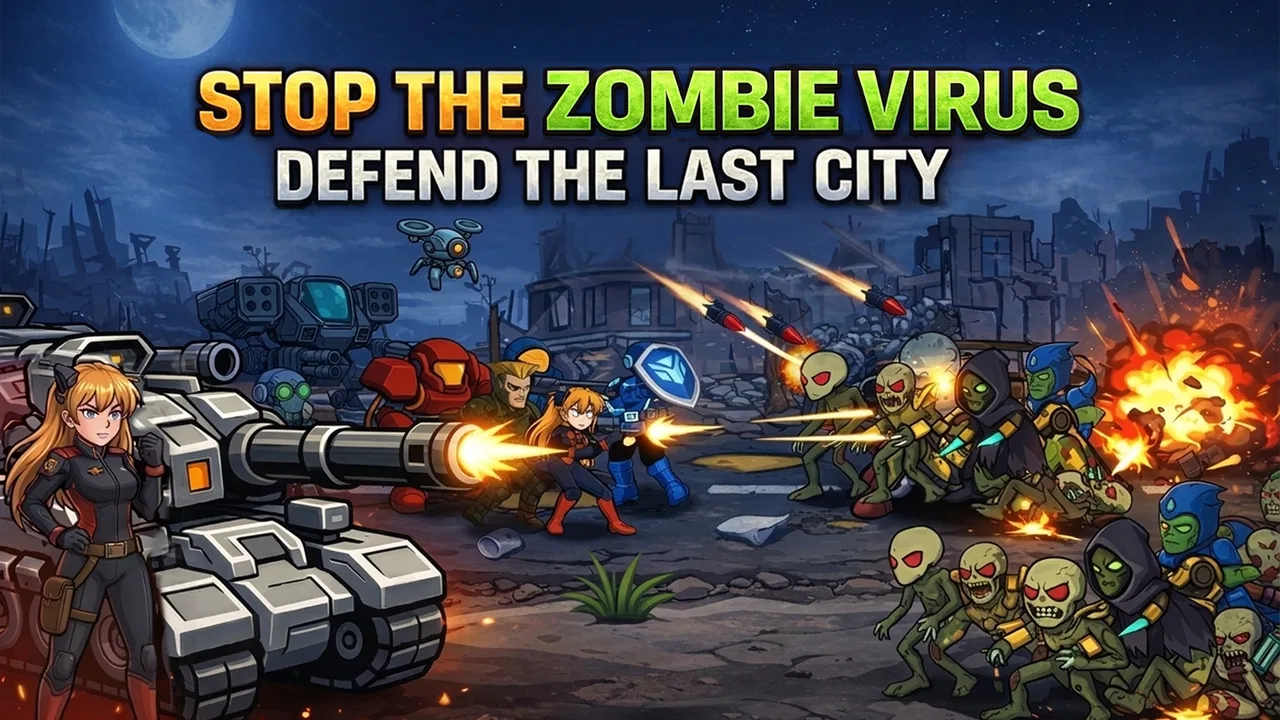
Hero Wars: Zombie Virus
- 4.5
- Rating
- 100.00K
- Installs
- Free
- Price
 Analysis by App-foxy
I spent time with Hero Wars: Zombie Virus as a strategy game built around a simple emergency: organize heroes and troops well enough to stop a spreading zombie outbreak. That premise is easy to understand, but the real question is whether the game can turn that idea into a satisfying routine rather than a quick novelty. My first impression was positive because the goal is immediately readable. You are not trying to decode a complicated setting before playing; you are making deployment decisions and watching those choices determine whether your defense holds.
Naomic Games keeps the presentation focused on the central conflict. The game is free to start, aimed at a Teen audience, and has a 4.5 average from around 859 ratings. Those figures suggest that the basic concept has connected with a meaningful audience, but they do not replace personal judgment. For me, the appeal depends on whether you enjoy adjusting a plan under pressure. If you prefer a strategy game where positioning, timing, and repeated attempts matter, this is worth considering. If you want a deep campaign with a large amount of documented content, you may find the early version more limited than established alternatives.
What the first sessions are really asking you to do
The opening objective is deliberately direct: deploy the available heroes and troops, then prevent the zombie threat from overwhelming the situation. I like that the first goal does not bury the player under unrelated tasks. It gives you an immediate reason to examine your units and think about how they work together. Instead of treating the outbreak as background decoration, the game makes it the reason every decision matters.
You May Also Like

 Blood Strike: 2.5 Anniversary
Blood Strike’s Loadouts Turn Every Drop Into a Tactical Gamble
A close look at Blood Strike’s custom loadouts: how fast access to signature weapons reshapes its battle royale rhythm, rewards preparation, and narrows the gap between fights.

 Pandora - Music & Podcasts
Pandora’s Music Is Easy to Start, but Harder to Recover
Pandora’s strength is its low-effort path from a seed to a station. Its weak spot is how much confidence it asks you to place in connection, setup, and quiet recovery.

 8 Ball Pool
 Is Built on Rivalries, Rematches, and Routine
A close look at the rivalries, rematches, shared routines, and unanswered safety questions that turn a quick pool match into a persistent mobile community.

 Samsung Music
’s Quiet Strength Is Playing What You Already Own
Its reach comes less from spectacle than from dependable access to a personal library. That simplicity is both the app’s strongest retention engine and its ceiling.

 AccuWeather: Weather Radar
AccuWeather Review: A Quick, Clear Forecast for Everyday Decisions
For everyday plans, the best forecast is the one you can understand quickly. AccuWeather makes rain timing, radar, and local conditions easy to act on, with a few trade-offs.

 Hill Climb Racing
Why Hill Climb Racing Still Turns Crashes Into One More Run
A tiny car, a bumpy hill and one more upgrade: Hill Climb Racing keeps resurfacing because its simple chaos makes every near-miss feel personal.
More From Our News Desk
View All News


That clarity is useful for short sessions. I can imagine opening the game while waiting for a bus, choosing a formation, testing a response, and closing it after a few attempts without needing to remember a complicated story thread. The same structure can also suit players who enjoy a more deliberate session, especially when a failed defense encourages them to reconsider deployment rather than simply repeat the same action.
One practical habit helped me approach the early stages more intelligently: I stopped treating every available unit as equally important. A crowded deployment is not automatically a strong one. I looked at where pressure was building, then considered which hero or troop placement could address that problem instead of scattering everything evenly. This is a small change in thinking, but it gives the strategy layer more purpose than simply filling every space as soon as possible.
The game is also easier to understand when you set a modest early target. Rather than expecting to master every encounter immediately, I focused on learning what caused a defense to fail. Was the front exposed, was support placed too far from the action, or did I commit resources before the threat became clear? That approach turns an unsuccessful attempt into useful information. It is especially helpful for players who normally abandon strategy games when the first setback feels like a wall.
Progress feels clearest when you compare decisions
In a game centered on heroes and troops, progress is not only about reaching the next stage. It is also about becoming better at reading the battlefield. I noticed that a successful attempt felt more meaningful when I could identify the decision that changed the result. That might be a more careful deployment order or a better response to the direction of the outbreak. The satisfaction comes from seeing a plan work, not merely from watching a progress indicator move.
That distinction matters because strategy games can lose their appeal when advancement becomes automatic. Here, the strongest reason to continue is the possibility that a revised setup will solve a problem that defeated the previous one. I found this more engaging than simply replaying a completed encounter without changing anything. Players who enjoy experimentation should get more from the structure than players looking only for a fast reward loop.
I also recommend making small changes between attempts. Replacing or moving everything at once makes it difficult to understand what actually helped. Changing one major decision at a time gives you a clearer sense of cause and effect. This is one of the most useful ways to approach the game: treat each attempt as a short test rather than as a demand to win immediately.
The early version number, 0.0.1, is important context for expectations. It signals that this is a very early build, so I approached the experience as a foundation rather than a fully mature strategy platform. The core idea is visible, but players should not assume that an early release will offer the breadth, polish, or variety of a long-established title. That does not make it unplayable; it simply changes what I think the game is asking from its audience. You are trying an emerging experience, not buying into a finished, content-heavy campaign.
How the challenge curve affects the rhythm
The best moments come when the outbreak creates enough pressure to make deployment feel consequential. If the answer were always obvious, the game would become a routine exercise. When a defensive arrangement fails, I want to understand why, then have a reasonable chance of improving it. That loop—observe, adjust, and try again—is the part that gives the strategy category its identity.
There is a trade-off, though. A player who wants constant action may find the planning pauses slower than expected. The game’s appeal is not based only on rapid reactions; it asks you to think about where your strength is needed. That makes it a better fit for someone who enjoys measured decisions than for someone seeking an arcade-style zombie game with nonstop movement.
My advice is to resist the urge to react to every threat at once. When several problems appear, identify the one most likely to collapse the defense and address that first. Spreading attention too widely can leave every area merely adequate, which is often weaker than securing one critical point and then dealing with the next. This kind of prioritization is a more advanced use of the game’s simple premise, and it gives experienced strategy players something to practice.
The challenge also benefits from accepting that a failed round can be informative without being enjoyable every time. Repetition is part of the design appeal, but it can become tiring if progress depends on trying the same arrangement over and over. I would have preferred a more clearly signposted sense of why a particular setup succeeded or failed. When that information is not obvious, the player has to infer it from the outcome, which may feel rewarding to some and vague to others.
Where the free model changes the decision
Hero Wars: Zombie Virus is free to download, which makes experimenting with it an easy decision. You can discover whether the deployment loop suits you without paying at the start. The important qualification is that it includes in-app purchases ranging from $0.99 to $99.99 per item. That range creates a meaningful difference between “free to try” and “free from spending pressure.”
I suggest treating purchases as optional until you understand the basic strategy. If the game is enjoyable only after buying an advantage, that tells you something about its long-term fit. I prefer to learn the available decision-making rhythm first, because spending early can hide whether I genuinely like the game or simply like moving past an obstacle quickly.
This is also where the game may lose players who want a completely even progression path. Someone comfortable with optional purchases may accept the trade-off, while a player who avoids in-app spending may become more sensitive to any slowdown or repeated attempt. Since the listed price is free, the sensible approach is to set a personal boundary before playing. That keeps the decision in your hands rather than letting frustration make it for you.
For a teenager, the Teen content rating is a useful signal about the intended audience, but it does not remove the need for sensible purchase controls. I would especially recommend that families review device spending settings before handing the game to a younger player. This is not a criticism of the zombie theme; it is simply a practical step whenever a free game offers paid items.
Who will stay with it, and who may move on
I think the game works best for players who like compact strategic problems. You do not need to be a specialist in complex tactics to understand the objective, but you do need patience when the first plan fails. The experience rewards people who enjoy asking, “What should I change?” rather than “Why did the game not let me win?” That mindset makes the outbreak scenario more interesting over time.
It is also a reasonable choice for short, repeatable sessions. A player with a busy schedule can approach one situation, test a deployment, and return later with a fresh idea. The game does not need to replace a large strategy title to be useful; it can occupy the smaller spaces in a day when you want a decision-making game without committing to a long campaign.
I would be more cautious about recommending it to someone who wants a richly documented world, a large roster with clearly explained roles, or a long-term progression system that already feels fully established. Because the current build is 0.0.1, the experience should be judged as an early-stage release. Players who need a polished, content-rich alternative right now may be happier with a mature tower-defense or squad-strategy game, even if those games lack this specific zombie-outbreak framing.
It may also not suit players who dislike uncertainty in strategy games. When the result does not immediately reveal which choice mattered, experimentation can feel less like planning and more like guessing. I found that the game became more enjoyable once I accepted the need to test ideas, but that tolerance varies from person to person.
How it compares with familiar strategy alternatives
Compared with a traditional tower-defense game, this title’s emphasis on heroes and troops gives the situation a more character-driven feel. You are not only arranging anonymous defenses; the language of deployment encourages you to think about the relationship between individual heroes and broader troop support. That makes it appealing if you want a zombie defense game with a stronger sense of units as participants in the battle.
Compared with a large squad-management strategy game, it is easier to approach. The outbreak goal is immediately understandable, and you can begin making decisions without learning a long list of systems. The trade-off is depth. A bigger alternative may offer more detailed team building, richer campaign structure, or a clearer long-term plan. I would choose this game for accessibility and quick experiments, not because it replaces every feature found in a full-scale strategy experience.
It also differs from action-focused zombie games. Those usually make the player’s direct movement or aiming the main source of excitement. Here, the more interesting question is how you prepare and respond through deployment. If you want to personally fight every wave, this may feel too indirect. If you enjoy being the person who organizes the response, the distance from direct combat can be a strength.
Small habits that make the strategy more rewarding
My first useful habit was to pause mentally before deploying anything. I looked for the point that would become dangerous if ignored, then built the opening around that concern. This prevents a common mistake: using the most attractive unit immediately simply because it is available. A strong-looking hero placed in the wrong situation can be less useful than a modest troop positioned where the defense actually needs help.
The second habit was to separate learning attempts from progress attempts. In a learning attempt, I deliberately tested a different arrangement even when I was not sure it would work. In a progress attempt, I used what I had learned and tried to execute a more reliable plan. This reduced frustration because not every loss felt like wasted time. It also made the pacing feel more deliberate.
Finally, I paid attention to whether I was continuing because I had a new strategic idea or because I was simply irritated by the previous result. That distinction is valuable in any free-to-start game with optional purchases. If the next attempt is motivated only by frustration, taking a break is usually better than spending money or repeating the same deployment. The game is most enjoyable when the player remains curious about the problem.
These habits do not require hidden knowledge or complicated preparation. They simply make better use of the game’s central decision: where to place heroes and troops when a zombie outbreak threatens to spread. They also reveal the main limitation. If you need a large number of distinct systems to stay interested, this focused loop may begin to feel narrow before long.
My verdict on the early progression
Naomic Games has a clear foundation here. The combination of heroes, troops, and outbreak defense creates an approachable strategy premise, while the need to revise deployments gives the early play a reason to continue. Its strongest quality is not the zombie theme by itself; it is the way that theme gives every placement a practical purpose.
The progression is most convincing when a new attempt teaches you something and the next success feels earned. It is less convincing when the game leaves too much of the result unexplained or when repetition replaces meaningful adjustment. The early build makes that balance especially important. I would not approach it expecting the depth of a fully developed strategy classic, but I would recommend giving it a fair trial if you like short tactical experiments.
With over 100K installs, it has already reached a noticeable audience, and its 4.5 average shows that many players have responded well to the concept. I still think the right recommendation depends on your expectations. Choose it if you want a free strategy game about organizing a response to zombies, enjoy learning through repeated deployments, and can live with an early version and optional purchases. Skip it for now if you need a finished-feeling campaign, dislike retry-based planning, or want direct action instead of battlefield organization.
My final view is cautiously favorable. It is best understood as an accessible early strategy experience, not a complete replacement for every established alternative. I would keep it installed for quick sessions and return when I felt like testing a new defensive idea. The concept is easy to enter, the decision loop has promise, and the free starting point lowers the risk. Just keep spending optional, judge progress by the quality of your decisions, and remember that the current version is still at the beginning of its development.
FAQs for Hero Wars: Zombie Virus
01What is the main objective of Hero Wars: Zombie Virus?
In Hero Wars: Zombie Virus, the main objective is to survive in a post-apocalyptic world overrun by zombies. Players must build and upgrade their base, recruit heroes, and strategize to fend off zombie hordes while completing missions and challenges. The game combines elements of strategy, tower defense, and RPG gameplay.
02What platforms is Hero Wars: Zombie Virus available on?
Hero Wars: Zombie Virus is available on both Android and iOS platforms. Players can download the game from the Google Play Store for Android devices and the App Store for iOS devices. Make sure to check the compatibility of your device to ensure optimal performance.
03Are there in-game purchases in Hero Wars: Zombie Virus?
Yes, Hero Wars: Zombie Virus offers in-game purchases. Players can buy various items, upgrades, and currency to enhance their gaming experience. While the game is free to download and play, these optional purchases can help speed up progress and unlock additional features. Always monitor spending, especially if children are playing.
04Can I play Hero Wars: Zombie Virus offline?
Hero Wars: Zombie Virus requires an internet connection to play. This is necessary for accessing the game's online features, updates, and multiplayer interactions. While some content may be accessible offline, a stable internet connection is recommended to ensure a seamless gaming experience.
05How do I recruit heroes in Hero Wars: Zombie Virus?
To recruit heroes in Hero Wars: Zombie Virus, players must progress through the game, complete missions, and gather resources. Heroes can be unlocked through in-game events or by using in-game currency to summon them. Each hero has unique abilities and skills that contribute to your strategy and gameplay.
Pros
- Engaging storyline with immersive gameplay.
- Diverse range of weapons and upgrades.
- Co-op mode enhances social interaction.
- Regular updates keep the game fresh.
- Intuitive controls suitable for all players.
Cons
- In-app purchases can be costly.
- Requires constant internet connection.
- Graphics may strain older devices.
- Repetitive missions after some time.
- Limited customization options for characters.

Hero Wars: Zombie Virus
Gallery